Instructor of Record
UC San Diego, Communication Department
- Politics of Bodies: Gender and Biomedicine (Summer 2021, Remote)
- “I’m so hormonal.” “Men’s brains just work differently.” “Ask your doctor about the little blue pill today.” We are constantly receiving and producing messages about gender and biomedicine in our everyday lives. This course provides a survey of some of the most common ways we learn about and perform gender, such as biology textbooks and pharmaceutical commercials, paying close attention to how biomedical authority has the power to produce “truths” about gender. In addition, we will build and use an analytical toolkit from Communication to evaluate and critique how biomedical messages about gender are produced and conveyed.
- Introduction to Gender, Race, and Sexuality (Fall 2015, Spring 2016)
- This course is meant as an introductory survey of topics relevant to Women’s and Gender Studies. The key concepts and themes we will examine include race, class, feminisms, gender/sex, body image and media, intersectionality, patriarchy and privilege, reproductive justice, sexuality and queer theory, social justice and human rights, globalization and neoliberalism, violence, conflict, and terrorism.
- Illness and Disability Narratives (Spring 2016)
- The care of the sick unfolds in stories. In recent decades, the literary and social scientific study of illness and disability autobiographies has emerged as a cornerstone of the medical humanities field. Stories of illness and disability possess a special power to engage their readers with the fundamentals of the human condition. While granting us a window into the ill person’s experience of their personhood and embodiment, memoirs of illness and disability can also serve to inform us about the larger social, cultural, and political conditions of our time. In this class, we will tackle questions such as: What does the telling and reading of narratives do for the ill or disabled individual? How can we effectively elicit, interpret, and act upon such narratives? Whose stories are told? Who is allowed to tell their own story? Who owns a story, and what is the role of co-authorship, power, and witnessing in telling and listening? What are the roles of power, hierarchy, prejudice, and oppression in telling and listening? How are individual stories impacted by the familial, cultural, social, institutional, structural, and political contexts in which they are told or heard? And how can personal stories be translated to political advocacy and action?
Graduate Teaching Consultant
UC San Diego Teaching & Learning Commons, Engaged Teaching Hub
- Specializations: Diversity, Equity, & Inclusion; Supporting Student Well-Being; Anti-Racist Pedagogy; Universal/Accessible Design; Remote Teaching; Active Learning; Syllabus Design; Teaching Observations and Consultations
Unpacking Anti-Blackness and Dismantling Systemic Racism in Educational Practices:
An Action-Oriented Learning Community for UC San Diego Educators
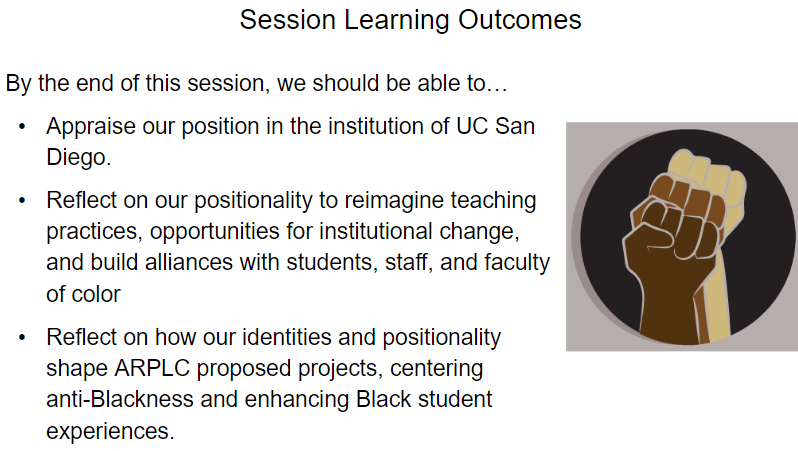
From 2022-2023, I had the privilege of developing and facilitating UCSD's Anti-Racist Pedagogy Learning Community (ARPLC). My responsibilities included designing content, training our facilitators, and co-facilitating for a group of fellows, among other things. You can check out our Winter 2023 and Spring 2023 syllabi here or dig into the two learning sessions I developed using the links below (click on the learning outcomes to download the slides)!
|
Examining Our Positionality In Institutional Power Structures
Session Reading:
|
Using Data for Anti-Racism & Anti-Racist Pedagogy
Session Reading:
|
Check out some of the workshops i developed as a graduate teaching consultant!
|
Evidence Based Pedagogy for Neurodiverse Classrooms
Students at UCSD learn in diverse and exciting ways. In this workshop we will discuss the varied forms of neurodiversity, its prevalence in our classrooms, and cover evidence-based strategies for teaching a neurodiverse population. You will also be given the opportunity to apply elements of Universal Design for Learning to reimagine one aspect of your teaching. |
Supporting Students While Preserving Yourself: Strategies for One-on-One Interactions
Students are facing unprecedented difficulties and are increasingly disclosing their struggles to faculty and instructional staff. Providing support to students is an important part of being an instructor; however, assisting students through crisis can be overwhelming and contribute to emotional burnout. In this webinar we share evidence-based strategies for providing emotional support to students in one-on-one interactions while setting appropriate boundaries and preserving your own emotional wellbeing. |
|
|
|
Teaching Assistant
UC San Diego, Communication Department
- COMM 100B: Communication, Culture, and Representation
- Professor David Serlin: Winter 2018, Winter 2019, Winter 2020
- Professor Barbara Bush: Summer 2018, Summer 2020
- COMM 100A: Communication, the Person & Everyday Life
- Professor Lilly Irani: Fall 2019
- COMM 10: Introduction to Communication
- Professor Fernando Domínguez Rubio: Fall 2017
- Professor Boatema Boateng: Fall 2018
- COMM 100C: Communication, Institutions, and Power
- Professor Barbara Bush: Summer 2017
- NMED K4360: Embodied Borderlands: Narrative Medicine and Diasporic Fictions
- Professor Sayantani DasGupta: Spring 2016
- NMED K4025: Illness/Disability Narratives: Embodiment, Community, Action
- Professor Sayantani DasGupta: Fall 2015